Thursday, December 17, 2020

Now is the... something-something.

So it's Winter. Or at least it's close enough. 

We pretty much remembered how to do this!
We're a few days shy of the solstice and I'm pleased to be able to communicate that Sound & Fury is slowly shuddering back to life. There's been A LOT™️ since last we spoke and as always the inclination is to apologize with incredulity at the length of my recent hiatus. But that is starting to feel vapid and pointless. If you're reading this it doesn't necessarily matter that it's been close to 7 years since last we spoke. Now here I go wasting airspace with something I'm essentially decrying. Hush now.

The events of the past year have cast much into stark contrast with our closely held assumptions and beliefs. For me it's been an introspective period, with no small share of personal growth and a search for balance and meaning in an otherwise topsy-turvy world. 
"But what does all of this have to do with beer?" I hear you ask. The answer is, like many things, as meandering as it is meaningful. I'll try to be concise, I'll probably fail. After all this is kind of just talking into a void so... Who cares?

I think in the end it has to do with beer because it has to do with everything. It's the 'community' stupid. That is of course the royal stupid, not writ large. It's the people; those we love, those we miss, those we help and those who keep us going. Beer, like most things in life is a vehicle for community. To share, to celebrate and maybe also to commiserate on occasion. We've been through a lot, and there's more to come so my hope is that I can participate communally by sharing the fruits of my labor with those I love. Additionally, right now it feels more important than ever to engage in tangible pursuits. To create things we can see, feel touch and in this case taste.
We want the grist. Gotta have that grist!

Dusting off the brewery after so long (more on that in a coming post), we at S&F were moved to consider timing. We were still in early fall and seeing no shortage of IPAs the feeling was to turn in a different direction. Enter: 'Winter's Discontent Spiced Ale'. It was a favorite of the early days, and something of a left-field entry in the Sound & Fury canon. A chewy, fruity number with festive spicing for that holiday kick. In attempting to re-create this tipple, I first consulted the digital oracle (the BeerSmith database) but finding not a whiff of the recipe I ended up having to go into the archives and read something I believe our ancestors referred to as a 'book'. It was a relic of the 20th century, paper bound in more protective materials to physically record thought.... I digress. Upon referencing the S&F brewery's original journal I was miffed to find that this recipe had been constructed upon a malt extract backbone in the pre-allgrain days. 

No matter, our intrepid brewers sallied forth and using guesstimates based on the original recipe, brewers intuition and a heaping dose of 'just winging it' we've come up with something we're quite proud to share. It is a somewhat by the books affair with a close to 75% Pale/Marris Otter grain bill, but with some cheeky Chocolate Malt added for color/depth and a smidgen of Smoked Peat Malt thrown in for... well for fun I guess. We also went a little adjunct-crazy with a punch of boil-time cardamom and cinnamon complementing the borderline iconoclastic Willamette and Saaz hop bill. All this is boosted with a dollop of black strap molasses mid-boil to make for an [un]intentionally massive winter warmer. Clocking in at an unprecedented 9% ABV this year's WD will warm the cockles of your cold-dark evenings with a complex spicy smoke flavor and rich mouthfeel that screams coziness. Stoke the fire and snuggle up under that blanket. Let's get through this "together", so we can be together.
 
Cheers!


Monday, May 6, 2013

Time Marches On/Events of Woe/New Dawn

So here I am again, beginning a blog in the manner I assume most do much more often than they'd like: Apologies to have been so absent of late, I guess it is kind of a mixture of the improving weather and beginning training for my next ultramarathon in earnest. The weather has been good to us, and as such we've yet to brew indoors. Its pretty freeing to be outside working and it also allows us to put off the consideration of burning propane indoors (maybe we'll never have to confront the issue?). There hasn't been a flurry of activity as with recent build days, but nevertheless it stands to reason that if one is to be incommunicado for nearly a month events will inevitably transpire. And transpire they have.

#1 - New Tap Handles

A friend of ours, upon hearing of our keezer endeavor, offered to share his CNC Router, in order to have a bit of fun making some tap handles. We were naturally quite excited to see what would come out of it, and disappointed we were not. I don't know if you'll see this but many thanks Rick! We'd love to reciprocate in some way for this awesome gift!

6 servings of tap-handly goodness

I'm really not sure how I've managed to avoid getting a picture of them in action. In fact, my focus has been less on photography and more on method and results of late. Maybe we need to draft an official photographer...

#2 - Damn You Hubris!

I'm fairly sure this was my fault. The wild boasting of my previous post has caused the ever giving goddess Ninkasi* to smite our efforts. I guess a picture is probably worth a thousand words, and indeed this is worth a moment of measured silence...

No one was hurt

*that's right, HISTORY LESSON! It seems these days if you've slick enough SEO and smart enough marketing you can supplant the gods themselves! It's a good job they make such good beer too ;)


#3 - To Old Beers and New

The aforementioned horror that elapsed comes, however, as a mere footnote to the announcement of two new beers! Just put into keg yesterday were Pistachio Porter v2.0 & the newest S&F creation - Halfwit IPA. The former is a altering of the original favorite. There's an argument to not fix something that isn't broken, but what about improving on something that's great? The porter has been a real hit, and we're taking it into flavor country with a more diverse grain bill and some adjunct help to smooth it out. We kegged it yesterday and couldn't have been happier with the provisional results. Fully fermented yet uncarbed and room temperature it is almost everything you'd want from a finished beer. It's complex, its rich and it will tell you a tale you'll not soon forget. The first hit is an upfront toasted note that belies the luxury of the new mouth-feel, exposing the rugged, robust roots of the style. But don't get complacent because go back for a second draw and you'll be seduced all over again but this time by an earthy nuttiness that delights the palette and nose in equal measure. Still to come for this seemingly well rounded brew - the pistachio treatment and carbonation/conditioning. I'm anxious to experience the results.

And of course, who could forget the Halfwit IPA - this most glorious blend of international styles pitting wheat against hop for supremacy in your glass and heart. We've had our greatest experiment with flaked wheat thus far and we think its shaping up swimmingly. It's a concoction of two-minds boiled with a healthy 4oz pile of Chinook and Citra hops that we think this is going to be a feisty brew that will hold its own in any arena. And just because we felt like it could maybe stand to be hopped all the more we've gone and thrown another full ounce of each hop into the keg to spice up the nose even more.

And as if that wasn't enough, we went for another of our crazy yeast experiments - we've fermented half of the batch with a Burton Ale Yeast (White Labs P023) for its fruity notes and the other half with California (White Labs P001) to get something of a cleaner standard IPA feel. Both have come out strong, but have a ways to go before judging, now comes the carb and and the chill. So far, the Burton is giving hints of Belgian spice and fruit notes without overpowering the way some Abbey yeast strains can, I'm optimistic about both but will want to put it to the vote. So get yourselves over to see us in a couple weeks time and we'll see which is best!

Saturday, April 13, 2013

Look on my works, ye Mighty, and despair!

This Sunday past (4/7) was a Red Letter Day in the annals of Sound and Fury beer service. After what seems like a much more significant time than it really is; and certainly much sooner than it had any right to be, the kegerator is operational!


It truly is a thing of beauty, and there's little better than kicking back in your garage and taking a pour of your own beer from your own draught taps. It makes even a chilly early spring afternoon manageable, and fills one's mind with fabulous daydreams of lovely long summer days kicking back with friends and enjoying a pint or two in repose and without a care in the world.

It has been a hoot to build and a will be a joy to serve from. Here's to many more homebrews to come!

In raising the door height, we've made room for a 5th keg too, which is nice... though not reflected in the taps on the front. This was because we're toying with the idea of the fifth tap being a stout faucet or something like that. Ruminations continue, and we've drilled and filled the hole for future expansion. In other news, custom tap handles are on the way!

Enjoy these pics of the final build and serving:

Weatherstripping on the freezer top, to keep the seal on the wood

Settling the collar into its new home - really digging the stain

Affixing our CO2 manifold for line tidiness

More faucet goodness!

And with a couple of tap-handle threads sitting around, I couldn't help but play around with these stylish tap-handles - not to be confused with the spectacular product that is to follow!

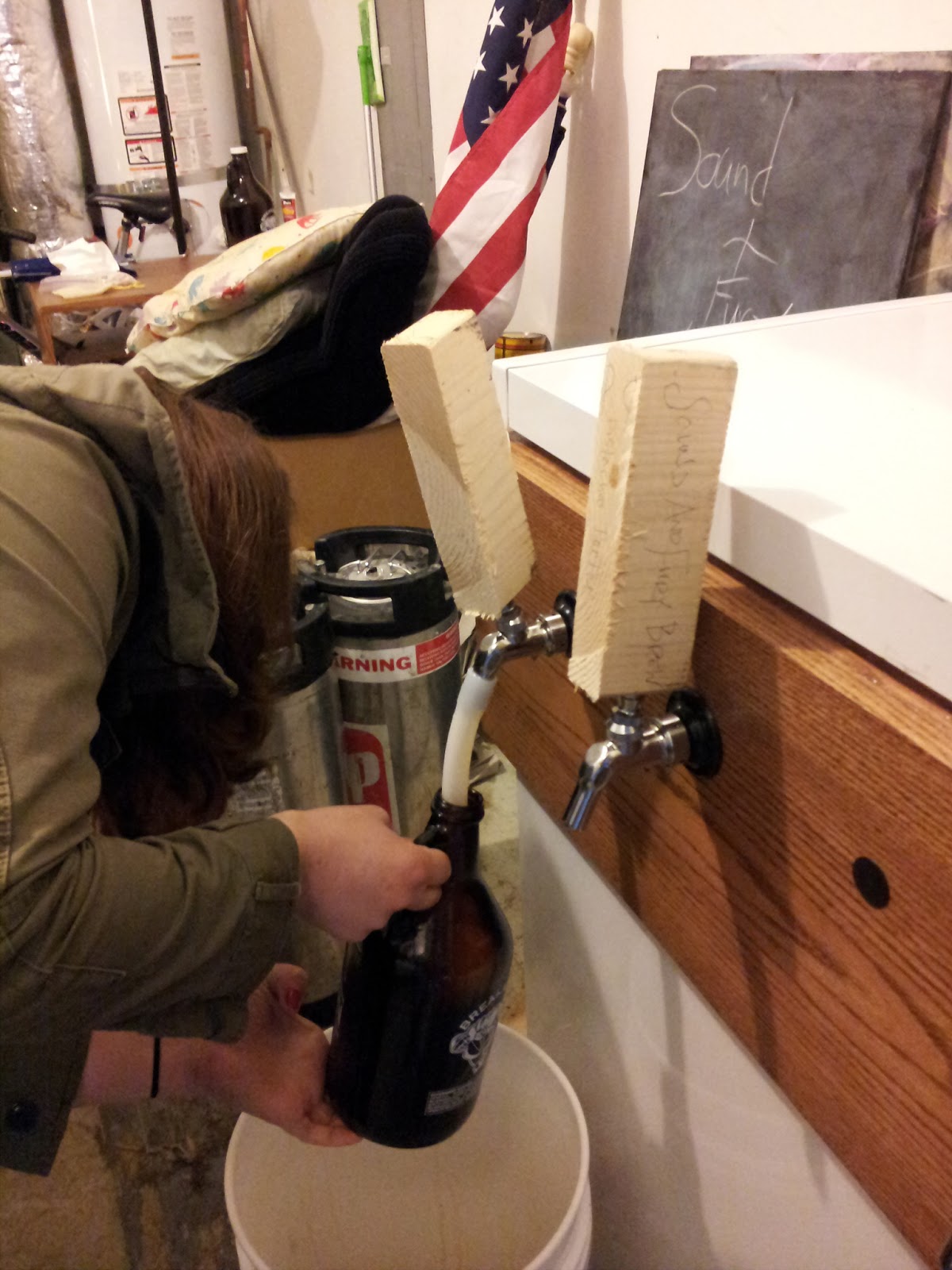
Gotta get a couple growler fills in

Monday, March 25, 2013

And now for something marginally different - Carpentry Edition.

As has been alluded to and flat out stated, we're building a kegerator! There's little sense in having these kegs filled with delicious beer if there's nowhere to keep them cool. And while it works, a picnic tap just gives a sub-par pouring experience on the whole.

Hooray for Cornys!

So as was previously shared, we've got our chest freezer and temperature control in house and hooked up. We're dispensing happily from it with our two picnic taps and our gas lines. We've actually had all the gear to set up our keezer for some time. All of it except the wood for the collar. The collar is the real beauty of this endeavor. It gives us the headroom we need to fit that extra keg in, and gives us something less dramatic to drill holes in, and at the same time maintains the structural integrity of the freezer itself.

We have decided to go with 2"x8" Fir for our main structure, as this gives us a nice solid base without breaking the bank. Then for flair, we're going to cover that with an outside layer of 1"x12" oak, with a rich Red Mahogany stain. She's gonna be a beaut!

Measuring out the 2"x8" Fir for the inner collar

I was working alone today, so there weren't a ton of opportunities for 'at work' shots. But I tried my best to document each step.

Setting the measured & cut pieces to make sure they're right (they totally were!)

Fixing the whole thing together with angle brackets and 3" wood screws

There was a curious moment in the making of the butt joints where I thought I was blowing it. I was drilling guide holes for the main connecting wood screws (at the outside of the joint coming into the smaller side pieces) and twice in a row the screw went loose right after it got a little ways into the adjoining piece. The heads would just loll to one side and spin in a wide, sad arc that made me think the inside had rotted out or something weird like that. Instead what had been happening was the screws were hitting a particularly gnarly knot in the wood, which was so hardcore that the screws were snapping off due to the pressure I was putting on them and the resistance from the stronger segment of wood.
Momentary woe gives way to ultimate relief - nothing is going to loosen that joint

Once it was all screwed together and fitted on the freezer, it was time to make a judgement call - would I get heroic and finish it as far as the staining? We want the Oak to be brilliant, so we want to do miter joints for maximum greatness. I was using a chop saw, and so I felt like it might be worth a go. I measured up a few times and made my marks and set the saw to a 45° angle then paused. In cutting the 8" wide Fir, the saw was not quite large enough to make the cut in one stroke, I had to flip the piece to get all the way through. Needless to say, this just about sufficed for 8" on a butt joint and so I couldn't fathom of a way to make it work mitering a 12" wide piece of Oak. Maybe there is one, but quite frankly I wasn't in a position to figure that out.

Next up, the circular saw! It happily had capacity to make 45° cuts, and was hand-held for extra ability to cut through 12" of luxurious Oak. And this brings us to the lesson portion of our time together ladies and gentlemen, boys and girls. The maxim is to measure twice, and cut once and its a good one, but why not go one better? In this instance I went by the rule of measure twice, cut twice. And boy-howdy did it save my skin. I decided I'd take the circular saw to a bit of scrap wood we had laying around to make sure it would work as intended. Sadly my steady hand wasn't so good with a hand-held and the wood I cut deigned to start smoking halfway through. Although if I had done my first cut on the Oak it would have been a much less happy occasion.

Down tools. It was time to relax, not worry and have a homebrew. I immediately admitted defeat. The mantra of this failure (if it could indeed be classified as such) is: "We need to do it right, not right now."

So the collar isn't ready to stain, and the tap holes aren't drilled. But my limits are happily in check and a not insignificant amount of the work was done. The Fir fits, and I played around with the taps on some scrap wood. This thing's going to rock!
Fully assembled and ready to rock - the inner collar

Gateway to the sweet ambrosia

Imagine these straight and nicely spaced - maybe even with a cheeky stout faucet on one end.
If you look really close, you can see where I tried the mitering on that last photo, I used the same piece of scrap for that and for test-mounting the taps (the 7/8" spade bit worked a treat!). Another great day with useful lessons learned and another step closer to a magnificent beer delivery service. Hey, and the beer wasn't half bad either, the picnic taps still get it into my glass ;).

Fancy a pint?

But, soft! What light, through yonder IPA breaks?

A delicious IPA. Yesterday.
It is the beer, that welcomes in the sun.

And with that it was spring. As has become typical around here we were enticed with gradually warming temps, only to be suddenly slammed by snow beyond vernal equinox. Don't get me wrong, I'm sure its worse back east (on both sides of the pond), but it was a most jarring contrast albeit a brief one. Thankfully that is behind us and Seattle is now quite balmy... at least by recent standards.

And to the matter at hand; our dear sweet libations. Much has happened in the intervening period since last we spoke. Our testing ground IPA is coming to fruition, and our Pistachio Porter has matured to term - both are excellent. Although at risk of falling foul of the trappings of hubris, I had fully expected that would be the case with the Porter. The IPA however, has surprised in spades. From a modest beginning with the simplest of grain bills and a moderate to aggressive hop schedule I had expected to come out with a serviceable yet somewhat hop-heavy end result. However, the beer we've ended up with is somewhat startlingly delicious. The balance of hops seems to have worked quite nicely, and instead of overwhelming the whole affair they instead have deftly complemented the malty goodness with but a hint of bitterness and a smooth, soft edge. Hop-heads might not sing its praises, but its got a decent identity and has been worthwhile beyond the simple exercise of finding how clear we could make a lighter beer and seeing the results of using but one style of grain.

So if you see me, give me a shout, we've a bonnie pair and the Amber is but a couple of weeks away. I think that might end up being the catalyst for some kind of hootenanny so mark you calendars for a weekend in early to mid April for Sound and Fury goodtimes. We've even been expanding our kegging capacity in order to mark the occasion.

See our kegs, see our kegs - made from real Stainless Steel...
We've added 8 Cornelius Kegs since we put the Porter on tap, so we're going to be needing some help sampling our wares (or we'll have a very unproductive next few brewery days). We're also going to be working on classing up our dispensing system. But that's for the next post.

Thursday, March 14, 2013

To keg... Perchance to serve.

When I started out, making 5 gallons of beer on the stove seemed like a lot, but still a manageable amount. Enough that I might realize the dream of drinking a bottle of my own beer. Times have changed, and so have I. With ~10 gallons a time coming out of the new system we have finally embraced the awesome power of the keg!

Our first kegs - two cornies, a 5lb Co2 tank and picnic taps.

We are now primarily going to be serving out of Cornelius kegs (a smaller, more user-friendly keg style that is now deprecated from the soda industry). With this luxurious problem comes the dilemma of how best to store and serve from these kegs at temperature worthy of the fruit of our labor. Enter the keezer!

A scrap wood preview of what is to come.
This brings me to another aspect of homebrewing that I've been thoroughly enjoying. I have never considered myself handy and I'd never want anyone relying on my construction work, but homebrewing affords both the scope and flexibility of amateur DIY projects that make even this novice dream of grand feats of home improvement. We built our brewery stand and its not immaculate but it works and its a tank. We'll build our keezer and I've full faith it will delight and dazzle (potentially in unequal measure and likely proportional to the amount of contents consumed).

The taps and such came in this week, and we're still making decisions on the wood. However that hasn't stopped me from unpacking everything and checking out what we've got to work with in the mean time. Enjoy these pics from an evening reveling in the anticipation of work and victory yet to be!

Brewmaster Pete pours the primary pistachio porter - carbed up and ready to roll

Our chest freezer - 7 cu. ft. Should be enough for 5 kegs once we get the collar on

Ranco Two-Stage Temperature control

Myriad parts - Perlick 525SS faucets, faucet wrench, shanks, gas manifold, tubing (both 3/16" & 5/16")

The perfect pour - the porter's looking fine and tasting smooth

Do you like luxury?

Finally set the regulator to be read from within the freezer.

Lots to be going on with here, and lots to be explained. I'm planning on having my camera handy during the build that I might expound upon each step, its virtues, vices and place in the brewing cosmos. Goodnight for now, and cheers to a future of quality brews served right. For in that deep of keg, what beers may come....

Tuesday, March 12, 2013

The Pistachio Diaries

Hey you pistachios! Get in my beer!

Over a month since brew day and the Pistachio Porter is finally taking shape. With somewhere in the region of a 9.5 gallon yield we decided we'd do a little experiment by splitting this batch over two kegs and conditioning each with a different amount of pistachio extract.  One has 27.5ml and the other 23.7ml (the latter calculated proportionally to the original mix and the first as a 'bumping up' experiment). Part of the fun was had via administering the pistachio extract into the bottom of the kegs using an infant medicine syringe.

Whilst we were at the brew house (wink, wink) last weekend having exciting adventures we decided to give these both a try, even though it had been less than a week. Initially we poured off the first few ounces into a jug, assuming a mess of sediment would come out. Happily it was pouring clean right from the get go (this has oft been my experience with darker beers). It was under-carbed but we had been carbonating at serving pressure to get a nice even distribution so it had only been at 7psi for 5 days. But there was potential in the body and already a decent mouthfeel.

Tasting out of the jug was pretty alarming, a lot of bitter and chemically notes came to the fore. That may have been because it was the first runnings, or even the vessel itself. I cannot be sure, but once we put some in a regular glass things got better pretty quick. It was at the very least suddenly recognizable as a serviceable replication of my prior efforts. Being tasted so young, there were some harsh flavors and inappropriate bitterness, and the pistachio flavors seemed a little more pronounced than I'd like. But on the whole I think that any real negative points are things that we feel will ebb nicely with another few days in the keg.

Side-by-side, despite the overwhelming nature of the pistachio at this point, I felt like the stronger mix was preferable. This could have been because it better cut the harsher bitterness of the base style. I was surprised by that as I had recalled a winning combination with the original proportions. But that's why we push the boundaries right? Why not chase that edge, that finer product,  that new horizon? I'm moved to muse that perhaps a more complex malt profile might be beneficial for future renditions of this ale. We'll search for the right mix until we know its just right.

Two New Beers

Carbing/Conditioning next week - An experimental IPA1, aggressively hopped and made with only a single base malt.
In fermentaton - A hybrid American Amber/British Bitter2 that fell foul of viciously chaotic circumstances.
Clear as a bell
1. The IPA, dropped clear and racked off the sediment

Today's tale concerns the unintentional hybrid Amber/Bitter we've concocted...

We started this past weekend with grand dreams of exacting and specific plans of controlled process and mimicking a specific beer. Several commercial breweries are kind enough to give folks a general approximation of what malts and hops go into their beers. One such which seemed like a widely available one for side by side comparisons was Elysian's Mensroom Red. Our plan was simple, to take the information on that page and use our knowledge (and exceptional software!) to try and get the best approximations of malt and hop amounts, mash schedule and yeast types to best hit bitterness, color and alcohol levels of the original beer. Through this we hoped we could come out with something that might at least stand up to a taste test, if not a full side-by-side comparison. Oh the ignorance and naivete of the inspired homebrewer!

The following is a lesson I'd learned before but had somehow deigned to forget for this exercise: 
ABC - Always Be Changing! Homebrew supply stores are to a great degree at the whims of the commercial brewing industry. The malt types that are in abundance are those that are grown and modified for various recipes favored by the local big players. It limits (or expands in some cases) what is available as excess for homebrew supply. Our recipe called for using a less common (though not unheard of) malt type as base and thus when supplies were purchased, the fact that the supply shop we settled on was completely out of that specific grain type was most alarming.
2. Into fermenters - an experiment with different yeast types

This led to a somewhat misguided attempt to substitute out various malt types and panic leading to bad choices. There was a safe conservative path to take and it was summarily ignored. We ended up with our smallest grain bill yet, and our smallest overall mash ever. This caused all kinds of observed problems with maintaining mash temperature to successfully convert starches to sugars (this may have been a limitation of our temperature gauging equipment). We added hot water, we added more hot water and when that appeared to fail we directly fired our Mash Tun, risking scorching the grains and making a mess of the whole thing. Luckily we managed to reach some kind of equilibrium and get a semi-decent mash (although it showed greater and lower than desired temperatures at all times). However, due to the measure of the grains and the chaos of the mash we were left with something that pre-boil, represented a significantly weaker beer than we'd planned. This is where the art and science of the process of brewing comes into play in its fullest force. Left with a beer with sugars less dense than desired, and an impending boil, we simply boiled the heck out of it and came out with something that we feel is going to be a worthy addition to our repertoire. There will be less volume, but that is certainly something we can live with.
The hop bed - post boil. Performs excellently as a filter bed for those undesirable and coagulated proteins

So the lesson learned (or perhaps reinforced) here is to always be thinking on your feet and open to whatever may be coming out of left field. Keeping your head and making good choices when things go wrong is essential in brewing as in life, if your best laid plans appear to be collapsing around you, take a moment and think about it. You are probably much more capable of improvising a win than you think at that very moment. I have a feeling the resultant beer of this past weekends session is going to be quaffable in the very least and has the potential to be the happiest accident of all. And even if it is an offense to the taste-buds, we still learned a lot and had a ball making it.

Come the end of this month we're going to have 3 beers on tap and another knocking on the door. Methinks some kind of social event is in order!

Monday, February 11, 2013

Been spendin' most their lives*, livin' in the All Grain paradise


And lo the day hath arrived!

Grains were mashed, water and wort were heated, boiled and chilled and all and sundry was washed, rinsed and sanitized. 'Twas a great day, with many wild successes and few setbacks which in truth ended up being minor in nature and highly educational. We ended up feeling like things were intuitive enough and our errors largely avoidable in future. Lets be honest here though, we could have messed it up considerably and still probably made a decent beer. But who wants decent beer? I vote for exceptional beer every time.

For starters we couldn't have asked for a better day in Edmonds, WA. It had been grey and rainy the whole week prior and driving north that morning things were looking a little misty from the Interstate. But the sun prevailed and everything had burned off by 10am. Being able to brew outside was great as using propane tanks the more air circulation we could get the better.  And the above timing provided the first lesson of the day - start early! After a 'quick' sit down to go over the schedule for the day and to get on the same page for the various upcoming tasks, we didn't really get going in earnest until about 11:30am. Things didn't seem too bad though, as we planned on a 6 hour brew day and with Winter receding here in the PNW we felt we had a decent buffer. Word to the wise - finishing up the boil and cleaning up in the dark isn't a deal breaker or even that challenging, its just ultimately better planning and easier on the brewers to get things done before sunset. So I'll be looking forward to some dawn brew days in future. That and maybe buying a flood-light...

Thursday, January 24, 2013

The Final Shipment Is In

Therminator et al arrived today. Big fun! Now I just need to pick up some Mash Tun insulation and a couple of lids and we are ready for final testing. Stay tuned!

Monday, January 14, 2013

A New Year, a New Domain and New Promise!

Hark! The frosty winter's chill is in full effect. Much has happened, waists have swollen and receded and the Sound abides, ever unmoved by humanity's holiday exploits. Sound and Fury Brewing has had some success amongst the inertia of the season; our holiday ale - Winter's Discontent Spiced Ale was a smashing success. So much so that not a one remains of the batch. It was a joyful celebration of winter warmth, with a lash of ginger, a hint of cardamom and a sprinkling of cinnamon and candied orange peel adding gusto to a modest ale that had room for more and took it on in spades. Fleet of foot on the palate and easy on the faculties this was truly one for a long delicious winter session and looking to be a favorite Sound and Fury seasonal. Keep an eye out for it again in the future.

In addition, we now bring order to your Internets with soundandfurybrew.com! It's official, that is now a thing and it will ever simplify... your rss feed. Potentially. Either way its good to have and a symbolic step of intent going forward for the new year.

Speaking of intent, onward marches the all-grain system! As previously noted all vessels are complete and the only missing links are a wort chiller (I'm thinking a Therminator is my best bet at this point) and one or two barbs and connectors. Once they are in place and I've insulated my Mash Tun (latest worst case scenario* testing was brutal on the keggle setup - ~30*F temperature drop over 1 hour) we'll be ready to rock! I'm going to be ordering these later in the week so look out for the first batch, with various January commitments and such it will be coming sometime in Feb! I have a feeling that first off the line will be a split 10 gal version of the Pistachio Porter.

There's still some work to be done on clearing the space...


*Tested strike water @ 172*F in uninsulated Mash Tun with no lid in <40*F ambient temperature

Saturday, November 10, 2012

Bottle Bombs Part II ft. The Souring of the IPA

CARNAGE!


Kablammo!
It appears to me that what bore fruit in batch #9 (Scottish Ale) had its origins in batch #8 (Cherry Stout). My first indication was a few days ago when I had a tasting at my Aunt's Day of the Dead party...

...The scene was set. It was over 2 months since I made it, personal tastings had been a roaring success and I too had the highest of hopes for people's enjoyment of my stout endeavors. But alas, the best laid schemes or mice and men go oft awry. I did tastings of the Cherry Stout along with the Sour IPA (batch #10) and that itself was something of a chaotic experience. Much like its predecessor, the IPA had clearly suffered from infection, though in place of excessive carbonation this one had soured like so many new age sours one might procure from several cutting edge micro/nano breweries these days. I personally am not a fan so this one has been hard to have tastings for. I seem to provide it from a position of apology, which sours (pun intended) the experience in some ways. Some loved it, some hated it and still others were indifferent and yet appreciative of the development and the sampling of new things.

And then the tasting of the stout.

I've been romanticizing this for some time it must be said. Meandering treatises on the pros and cons of aging and fanciful yarns of harsh winter nights being warmed by a feisty fruity stout holding the night at bay notwithstanding, it has been something of a disappointment.

The party in full swing, I announced the tasting of the stout and friends and family gathered around in eager anticipation of the fruit of my labor. The textbook bottle-opener hiss... and then more. Much more. A fully bonafide gusher. This wasn't meant to be. The stout was supposed to be different. It was the Scottish that was the aberration. But alas it seems it wasn't to be, the Scottish was a victim of the Stout's intransigence.

When cooled sufficiently they are palatable, pretty darn good to be honest, and some are more explosive than others. A perfect example of this was coming home from work last night to the smell of dried stale beer from an unknown location. After a bit of investigation it turned out it was coming from everything in the brewing closet!

What goes up...

...must come down.

An oddly cool looking configuration.
For some reason the peripheral bottles were untouched

This was the real deal Holyfield ladies and gentlemen. None of this subtle cracking and leaking and sitting straight up belying its shattered nature. If not for the box it was in we would have been digging shards of glass out of pretty much every surface in the closet. 

This experience leaves me feeling rather sanguine nonetheless. I kind of enjoy the clean up as it is a task a brewer would undertake and by doing it I feel like more of a brewer. We can chalk batch #8, #9, #10 up as mistakes (in part, it must be said, truly beautiful mistakes) but the scare of #9 gave birth to a much more thorough cleaning and sanitization routine. Batch #11 (Winter's Discontent Spiced Ale) is looking pretty clean and tasting good. It'll be going into the bottle sometime this week and the ginger is starting to ease off allowing for a more complex flavor profile.

Looking to the future, I think its time to dust off the old favorite, the genesis of endeavors. I think next on the docket is to be the good ol' Pistachio Porter. And lets not forget that just on the horizon is an all grain paradise...

The Bayou Classics are in and testing well!

Saturday, October 27, 2012

To let it be or not to let it be... that is the question?

The question of age and conditioning in beer is as important and potentially contentious as it is in wine (and people). The very act and method of brewing is a study in time and patience. It is a commonly held belief that the IPA is the beer of youth. A young IPA holds more of its hoppy and bitter edge, and this will mellow out over long periods of aging. So as the theory goes, taste early and taste often! I must admit to having been ignorant of this at the outset, and the first two IPAs I made suffered the whole 3-4 week bottle conditioning process without a sampling. However, do not misunderstand me here, they were fine beers, and have done naught but spur me on in my forthcoming brewing endeavors. But can I go forward living with the doubt? What of their status at week 1 or week 2? As I learn more about this style (and rationalize my process) I see that there's little to be lost in having the complete experience of each beer one makes. I'm currently only brewing 5 gallon batches, and whilst that doesn't leave huge tracts of room for waste, one or two bottles in the early weeks of conditioning probably wouldn't impact things too much. After all this remains an exploratory phase.

We all have our own barrel warehouse right? 

Which brings me to a current conundrum, which I am going to say is providing an exciting learning curve! As summer has faded and the foreboding clouds and ominous nights are drawing in, one seeks greater comfort than can be found in the arms of a crisp lager or summery hefeweizen. I seek now instead the velvety security blanket of the stout to ward off winter's chill. In a seemingly prescient move, I actually made my stout in the depths of August's summer reign; reasoning that I'd miss it were it not to be ready until the following spring (I made it a cherry stout to afford a fond reminiscence of Summer's glory). And in truth I've been as patient and faithful as I could have hoped. It was bottled and primed two months to the day after it had been tucked in for fermentation, and now I sit here musing after 20 days conditioning.

I'll level with you here and now; I have tasted it and not just at hydrometer readings. I had a glass that somehow(!) got left over from bottling, and after about 18 days in conditioning I cracked one open to try it. Perhaps somewhat predictably it has proved delectable. The sourness of the cherries (more about them another time) really offsets the sweetness and cuts the heaviness. But now I research the style more and more and am left with one stark realization: conventional wisdom dictates that stouts (and particularly Imperial Stouts - this bad boy clocks in at a burly 9.6% ABV) are aged for near implausible* lengths of time. I feel I should probably go anywhere up to and beyond a year for a truly well aged stout, which gives me pause. I want to live this stout now and enjoy it over the winter months, but in such small batch size this would surely belie its true character. Approaching 3 months aged it would seem silly to go on a spree of consumption and polish it all off before the year is out, but it is so good! The better parts of myself will have to be disciplined and maybe I should trick myself into stowing 2-4 bottles somewhere that I cannot get at to afford the true stout experience. Where an IPA can pass you by fleetingly if you linger overlong, hubris can have you chasing things in a stout that are yet to be. A study in wistfulness if ever there was one. Is patience the ultimate virtue?

*At least for this eager new brewer

Friday, October 12, 2012

The New Rig - Part #1: Keg Procurement (Incl. a short discourse on All-Grain brewing and morality)

First of all, major shout out to Scott Kaczorowski - he put together the most viable looking guide for making my own All-Grain brewing system. I looked at many and found the 3 tier, gravity-fed system to be the best use of my means and level of expertise. As such I see this as most homebrewers probably do, as a stepping stone. I'll probably always want to add things and simplify/sophisticate my set up, but Scott made this brilliant set up seem achievable for even this metal and wood shop novice.

At the heart of this system is the time-honored and brutal simplicity of man vs. nature. Harnessing the awesome natural power of gravity to produce delicious and life-affirming results. Also, you might get a bit of a buzz for your trouble ;). In its most basic form, a 3 tier gravity-fed system has a vessel for each of the imperative steps of all-grain brewing:

  1. The top Keg - Hot Liquor Tank (HLT) - this is where the water for the Mash is heated to the required temperature.
  2. The middle Keg - Mash/Lauter Tun (MLT) - this is where said heated water Mashes the grains by virtue of its temperature creating enzymatic activity enough to convert malt starches into delicious fermentables. This vessel also serves the double purpose of being where Lautering takes place. This is the process of flushing water through to extract said fermentables from the spent grains 
  3. The bottom Keg - Boil Kettle - does exactly what it says on the tin. This is where the extracted fermentables (aka wort - pronounced wert*) are boiled and any hop and special late additions are made.
So I made my decision to make keggles, as that is obviously the most aesthetically pleasing route one can take here (chicks just don't dig the cooler man!). It seemed like a cheaper and more fun way to go about things, and the idea of building it myself is and was appealing.

The first question was how to go about it, as I'd read many articles on the shady business of the keg black market. I guess there's a whole ethical question about where resold kegs come from and how they are acquired. I used craigslist to get mine, and some transactions were not without moral ambiguity. For instance, the first one I ended up with was plastered with stickers from nearby paragon of craft ales, Fremont Brewing. This stank to high heaven of course, but I bought it anyway (I had driven all the way up to Snohomish for it after all). A couple hours on the drive home spent wrangling on the morality of cutting it up and stripping the stickers and I knew what I had to do. I returned the keg to Fremont Brewing at the next business hour opportunity and asking for nothing was gratefully treated to a growler of my choice on the house (gotta love their Interurban IPA). The beer was good, but the feeling of having done the right thing was even more satisfying. I like to think I notched a couple of brew-karma points that day.

After this episode my searches were a little more careful and I was more thorough in finding out the origins of my purchase. In the end I have 3 units which are of satisfactory origin. I have one Anheuser-Busch one, which was already converted before I bought it, one Heilemann one (a now defunct mega-brewery) and one Coors one (I mean come on... Coors? Really?).

Keggley goodness!
Also pictured: a 7.75gal Sanke Keg I got ahold of (which I'm still scratching my head over using), my weldless Mash-Conversion kit and obviously a drill. And that gives me a excellent segue to...

...Coming Soon - Part #2 - Cutting & Drilling! Gotta run folks, I have a Spiced Winter Ale that's calling to me with its Siren Song and thankfully for me won't make itself! 


*I know you're probably excited about the fun and arbitrary brewing jargon being thrown around here. I know I always have a hard time explaining to people whys and wherefores behind brewing terms. My favorite exchange was when it came time to pitch the yeast on one batch. My girlfriend asked me, "What does 'pitch' mean?" and my lame response: "Putting it in."  This and much more bizarre wordsmithery (that's right, I said it!) awaits the inquisitive new homebrewer!

Monday, October 8, 2012

Batch #8 - Cherry Stout Bottling Day


28 bottles all sanitized and ready to go


This is one that I've tried to age for a while. I made it on 8/6/12 from a Papazian recipe base, and I have been waiting with bated breath for it whilst also trying to age it as long as possible. In the end I bulk aged it for exactly 2 months, bottling on 10/6/12. This one had been a challenge to find the required cherries. I had wanted to get fresh ones, but it seemed that was not to be. A devastated sour cherry harvest and grocery stores' general proclivity toward sweet cherries meant I had to find other options. I guess I could have gone to the source to try and get the fresh stuff, but I was getting itchy brewing hands and so I opted for Oregon Fruits Canned Sour Cherries. I used the whole 8-pack and as they were already pitted and in water I was able to just put them all in the primary for a week.
I'm going to try and condition this one for a month or so. There was enough for 21 bottles, and nearly a pint left over. I decided to just celebrate and drink it. It was pretty glorious, leaving potential for something stellar post carbonation. I carbonated with 3.5oz. corn sugar in a pint of boiling water. I was sure to mix it evenly to avoid disproportionate carbing.

There was still a little yeast activity, but it was time.
O.G. 1.102
F.G. 1.029
Proj. ABW - 7.7%
Proj. ABV - 9.6%

Bottle Bombs!

Not looking bad...
Unfortunately batch #9 contracted some kind of infection between primary and secondary fermentation (we've since gone nuclear on all our equipment with Star San). Based on the research I've done it seems this was some kind of Lacto Bacillus infection. While not a show stopper it does render this batch somewhat... experimental shall we say. Some of them are turning out fine, others very heavy with sediment, and yet others gushing multiple feet in the air upon opening.

This seems pretty rare but I've read stories, some sounded pretty dangerous and messy - especially this one. So one day we hear a thudding sound and search the whole apartment looking for something that had presumably fallen off a shelf or similar. Finding nothing we continued our regular evening. Later when coming to check on a batch in our brew closet I found a small pool of beer in the top of our primary fermentation bucket. My first thought was that the primary had blown out of the fermentation lock, but a cursory taste didn't gel with the IPA I'd recently tucked away. Eventually I noticed that the beer was dripping down from the shelf above, the bottle shelf. All the bottles looked fine from the top down, but all were sitting in a puddle of beer. I ended up having to remove the lot to check each one.

See the odd one out?
How about now?
Looks like this one broke clean
Really something of a lucky near miss

So one of these bottles had the bottom shear clean off and split in half, with the upper portion sitting in the newly widened base. It was a hassle to clean up the whole closet, two fermenters and 20-30 bottles, but I was glad to have dodged a bullet in terms of injury and property damage.

Lesson learned: mix the priming sugar more thoroughly. I'm not sure if this would have helped what with the Lacto infection, but its good practice anyway and I have had uneven conditioning with less deadly consequences. As for #9, I think I'm going to put it away and see if it sours up. But it might be a lost cause depending on my ongoing bottle needs. Either way there will be kegging in my future.